The Great HDR Lie: Why Your HDR Looks Washed Out (And Best HDR Gaming Monitors)
By Pofari Gaming Staff • Updated January 2025
This content contains affiliate links. We may earn a commission if you make a purchase through these links.
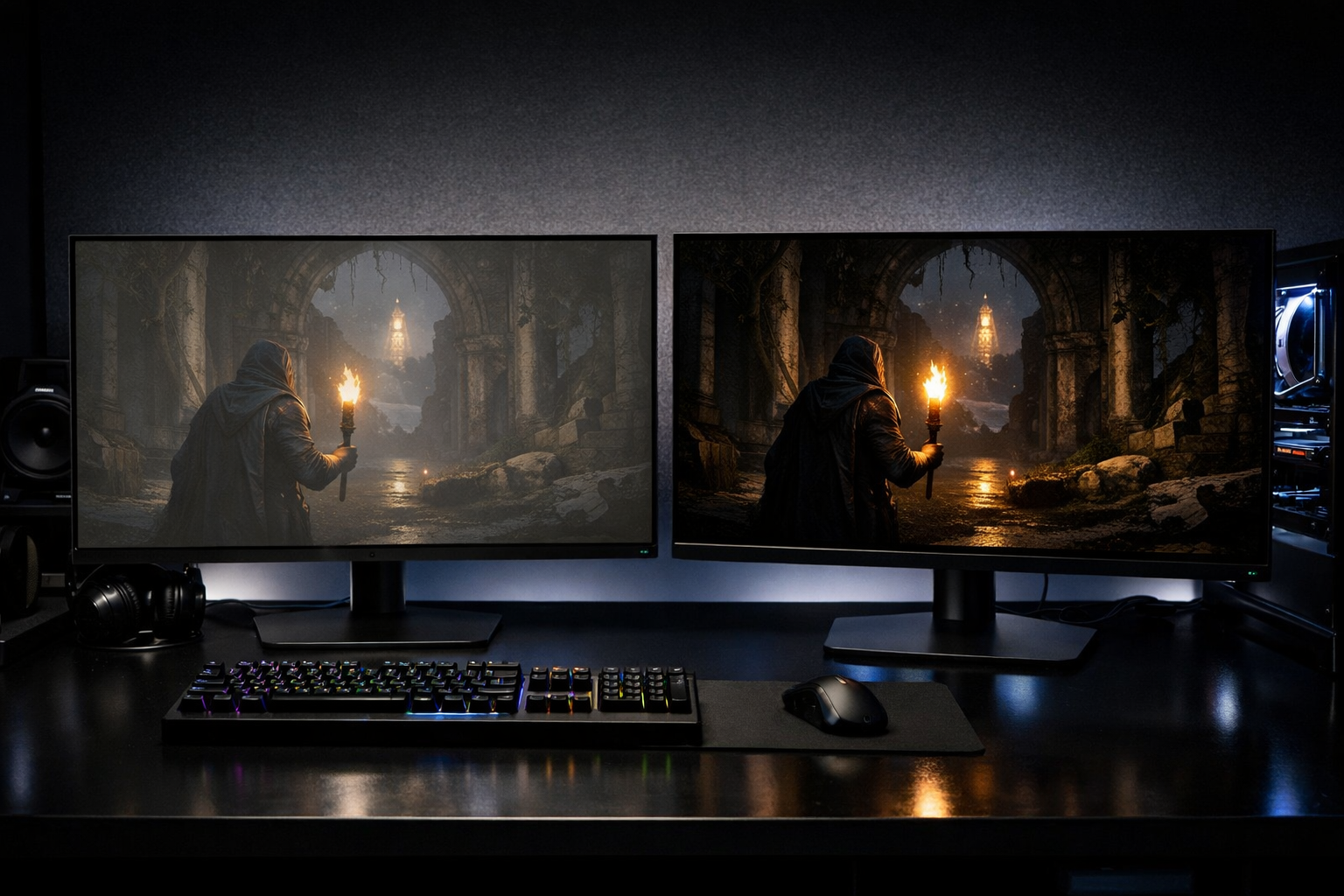
If your HDR looks washed out, flat, or even worse than SDR, you’re not crazy, and your eyes are not broken.
You’ve most likely fallen into one of the biggest traps in the monitor industry: fake HDR.
Terms like HDR, HDR 400, or even “HDR Ready” are heavily abused in marketing.
Manufacturers know most buyers don’t understand what real HDR requires, so they slap the HDR label on monitors that simply cannot display it properly.
This article will teach you:
why HDR looks washed out on most screens,
what HDR 400 actually is (and why it’s terrible),
which popular monitors fail at HDR,
and what to buy instead if you want real HDR in 2026.
Why HDR Looks Washed Out on Most Screens (The HDR400 Trap)
Here’s the uncomfortable truth:
HDR is not a software feature. It’s hardware.
Most gaming monitors advertise HDR, but what they really support is HDR 400, the lowest possible HDR certification.
HDR 400 does not require:
local dimming,
high peak brightness,
or meaningful contrast improvements.
So what happens?
The monitor receives an HDR 1000 signal, but the hardware can’t display it.
The result is:
grey “blacks” instead of deep blacks,
muted highlights,
flat contrast,
and an overall washed-out image.
In many cases, HDR 400 looks worse than SDR, because the monitor stretches brightness it cannot physically produce.
That’s why so many people turn HDR on… and then turn it off five minutes later.
The “Fake HDR” List: Popular Gaming Monitors to Avoid
These monitors are extremely popular, widely sold, and heavily marketed as “HDR gaming monitors”, but fail completely at real HDR.
They support HDR signals, but lack the hardware to display them correctly.
The Fake HDR Hall of Shame
ASUS TUF VG27AQA1A
LG UltraGear models with HDR400
Many budget MSI and Acer gaming monitors labeled “HDR Ready”
The common pattern:
HDR 400 certification
No local dimming
Peak brightness far below what HDR requires
These monitors are not broken, they’re just misrepresented.
They are fine SDR monitors.
They are not HDR monitors.
What Is Real HDR? (Stop Buying Backlights, Start Buying Dimming)
Real HDR is not about resolution.
It’s not about refresh rate.
It’s about contrast control.
Real HDR requires at least one of the following:
HDR 1000+ peak brightness
Local dimming (Mini-LED)
OLED panels with per-pixel lighting
This is the key concept most buyers never hear:
“HDR is about dark and bright existing at the same time, not just more brightness”
Without local dimming or self-emissive pixels, a monitor cannot do HDR, no matter what the box says.
The Best HDR Gaming Monitors of 2026 (True HDR Only)
These are monitors that actually deserve the HDR label.
No HDR400.
No marketing tricks.
Just real HDR performance.
HDR1000 · Mini-LED · Local Dimming
The KTC Mini-LED 27” is one of the most affordable ways to experience true HDR without compromises.
Unlike HDR400 monitors, this display uses local dimming, allowing dark and bright areas to coexist properly on screen.
The result is deeper blacks, brighter highlights, and real contrast, the core of HDR.
This is the minimum level you should consider if HDR matters to you.
HDR1000+ · Advanced Local Dimming
The Samsung Odyssey Neo G7 takes HDR further with more aggressive dimming zones and stronger brightness control.
This monitor finally shows:
specular highlights,
proper shadow detail,
and consistent HDR tone mapping in games.
It’s premium, this is where HDR starts to look the way it should.
OLED · Pixel-Level Lighting
OLED remains the gold standard for HDR.
With self-emissive pixels, the LG UltraGear OLED delivers:
perfect blacks,
infinite contrast,
and unmatched HDR depth.
If you want peak HDR gaming experience available in 2026, this is it, no marketing tricks, no compromises.